3 Unique Benefites of ETFE Film Architecture: Benefits, Design & Applications Beyond the Water Cube
ETFE film architecture is the key of success. While the Beijing Water Cube brought ETFE film architecture to global attention, the applications of this innovative material extend far beyond iconic stadiums. As a lightweight, durable, and highly transparent polymer, ETFE is revolutionizing building envelopes for atriums, facades, and roofs across commercial, educational, and public sectors. This guide explores the substantial benefits and critical design considerations of using ETFE film in your next architectural project.
ETFE film architecture introduction: Redefining Modern Architecture
The Beijing National Aquatics Center, known as the “Water Cube,” brought ETFE (Ethylene Tetrafluoroethylene) film into the global spotlight. But this innovative material is far more than a one-project wonder. Today, ETFE is revolutionizing architecture by enabling the creation of large, light-filled, and energy-efficient buildings. This article explores the practical benefits and critical design considerations for specifying ETFE in your next project.
Unparalleled Benefits of ETFE Cushion Systems
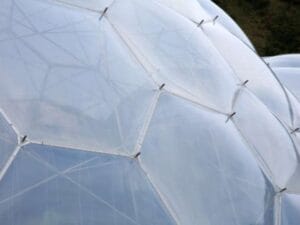
Architectural ETFE membrane is not used as a single layer but typically as inflated cushions or pillows. This system delivers a powerful set of advantages:
- Extreme Lightweight: ETFE cushion structures are approximately 1% the weight of an equivalent glass panel. This dramatically reduces the load on the supporting steel structure, leading to significant cost savings.
- High Light Transmittance: ETFE transmits more light than glass (up to 95%), creating bright, daylit interiors that reduce the need for artificial lighting and lower energy consumption.
- Superb Insulation: The air-filled cavity within the cushions provides excellent thermal insulation (U-values as low as 0.4 W/m²K can be achieved with multi-layer systems).
- Self-Cleaning Properties: The non-stick surface of ETFE allows rain to wash away most dirt and debris, minimizing maintenance costs.
- Design Flexibility: ETFE can be printed with frit patterns to control solar gain, and cushions can be formed into almost any shape, allowing for breathtaking organic designs.
Key Design Considerations for a Successful Project
Integrating ETFE requires specialized knowledge. Here are the critical factors to address early in the design process:
- Structural System Design: The primary steelwork must be designed to accommodate the specific loads and support geometry of the ETFE system. Collaboration between the architect, structural engineer, and ETFE supplier is essential from the outset.
- Cushion Design and Engineering: This includes determining the number of layers (usually 2-5), the air pressure system for inflation, and the design of the aluminum perimeter extrusion that clamps and seals the cushion.
- Environmental Control: A key feature is the ability to control solar gain. This can be achieved by using multi-layer cushions, printing frit patterns on the film, or even creating a multi-chamber system where the opacity can be adjusted.
- Acoustic Performance: While ETFE itself is not a significant acoustic barrier, the entire assembly (including the air gap and any secondary layers) can be engineered to meet specific acoustic requirements.
- Fire Safety: ETFE is inherently flame-retardant. It will melt away when exposed to fire, creating a vent that helps prevent smoke buildup, which is a significant advantage in large spaces like atriums.
The Project Workflow: From Concept to Completion
- Concept & Feasibility: Initial discussions with an ETFE specialist to assess design intent, budget, and timeline.
- Detailed Design & Engineering: The ETFE supplier’s engineering team develops detailed drawings, performs structural calculations, and models environmental performance.
- Fabrication: The ETFE film is cut, printed (if required), and welded into cushions in a controlled factory environment.
- Installation: Specialized teams install the cushions onto the completed support structure, followed by commissioning of the inflation and control systems.
Conclusion: Building a Lighter, Brighter Future
Architectural ETFE membrane is no longer an exotic material but a practical and sustainable choice for modern architecture. Its benefits in weight savings, natural lighting, and energy efficiency are undeniable. By understanding its properties and engaging with experienced partners early in the design process, architects and engineers can unlock its full potential to create iconic, high-performance buildings.
Are you considering ETFE for an upcoming project? Our architectural specialists are ready to consult on your design. Schedule a free feasibility review today.
ETFE film represents a paradigm shift in architectural design, offering a unique combination of performance and aesthetics. By understanding its full potential and technical requirements, architects can create buildings that are not only visually stunning but also more sustainable and efficient.
Considering ETFE for your next project?
Check our ETFE film and connect with our architectural specialists: ETFE film