PTFE vs PVDF: The Ultimate Guide for Selecting the Right Fluoropolymer
Selecting the optimal high-performance plastic is critical for product longevity and performance. The choice between PTFE vs PVDF is a common crossroads for engineers designing components for chemical, electrical, and mechanical applications. While both are outstanding fluoropolymers, their properties differ significantly. This guide breaks down the 5 key differences between PTFE and PVDF, providing a clear framework to help you select the right material based on your specific requirements for chemical resistance, temperature, mechanical needs, and budget.
In the world of high-performance plastics(ASTM standards for chemical resistance testing), selecting the right material is a critical decision that impacts product performance, longevity, and cost. Two of the most common fluoropolymers, PTFE (Polytetrafluoroethylene) and PVDF (Polyvinylidene Fluoride), often come up as options for demanding applications. However, they are not interchangeable. Choosing incorrectly can lead to premature failure, safety issues, and unexpected costs. This guide provides an in-depth, engineer-focused comparison to help you make the right choice with confidence.
PTFE Deep Dive: The High-Performance Benchmark
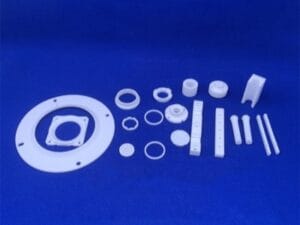
PTFE, commonly known by the brand name Teflon®, is renowned for its exceptional properties. It boasts the highest continuous service temperature of any major fluoropolymer, typically up to 260°C (500°F). Its most famous characteristic is its extremely low coefficient of friction, making it the ultimate non-stick material. Chemically, it is almost completely inert, resistant to virtually all aggressive chemicals and solvents. However, PTFE has limitations: it is relatively soft, has poor abrasion resistance, and can be susceptible to “cold flow” or creep under continuous load. You could select custom PTFE parts at our site.
PVDF Deep Dive: The Robust and Versatile Workhorse
PVDF (e.g., Kynar®) offers a different set of advantages. While its maximum continuous use temperature (around 150°C / 302°F) is lower than PTFE’s, it possesses superior mechanical strength, hardness, and abrasion resistance. It is also highly resistant to UV radiation and weathering, making it an excellent choice for outdoor applications. PVDF is inherently flame retardant and exhibits excellent purity, which is crucial for semiconductor and lithium-ion battery applications. A key advantage is its ease of processing via extrusion or injection molding. You could elect PVDF products at our site.
Chemical Resistance: The Core Difference in PTFE vs PVDF
When evaluating PTFE vs PVDF for aggressive environments, chemical resistance is often the deciding factor. PTFE (Polytetrafluoroethylene) boasts nearly universal chemical inertness. It is resistant to virtually all industrial chemicals, including strong acids, bases, and solvents, making it the go-to choice for gaskets, seals, and liners in the most corrosive applications, such as those in the chemical processing industry.
PVDF (Polyvinylidene Fluoride), while also highly chemically resistant, has a more selective profile. It performs exceptionally well against halogens (like chlorine), strong acids, and oxidizing agents. However, it is not recommended for use with strong bases (like concentrated caustic soda), polar solvents, or some ketones. This makes PVDF an excellent, cost-effective choice for piping, tanks, and valves handling chlorinated fluids or bromine.
Head-to-Head Comparison Table
This table provides a quick, at-a-glance comparison of key properties.
Property | PTFE | PVDF | Key Takeaway |
|---|---|---|---|
Max Continuous Temp | ~260°C | ~150°C | PTFE wins for extreme heat. |
Chemical Resistance | Exceptional (Inert) | Very Good (Resistant) | PTFE is superior for the harshest chemicals. |
Mechanical Strength | Low (Soft) | High (Rigid) | PVDF is better for structural parts. |
Abrasion Resistance | Poor | Excellent | PVDF lasts longer in wear applications. |
UV/Weather Resistance | Good | Excellent | PVDF is preferred for long-term outdoor use. |
Processability | Difficult (Sintering) | Good (Extrusion, Molding) | PVDF is easier for complex shapes. |
Cost | Moderate | Moderate to High | Cost varies by form and grade. |
Application-Based Recommendations: Making the Final Call
Your application’s specific requirements should be the final deciding factor.
Choose PTFE for:
Non-Stick Surfaces: Cookware, food processing equipment linings.
High-Temperature Seals & Gaskets: Where chemical resistance is paramount.
Low-Friction Bearings: In non-loading or low-speed environments.
Extreme Chemical Lining: For tanks and pipes handling aggressive reagents.
Choose PVDF for:
Structural Components: Pump impellers, valve bodies, and chemical-resistant pipes.
Outdoor Applications: Architectural coatings, wire and cable jacketing.
High-Purity Systems: Ultrapure water pipes, semiconductor wet benches, battery binders.
Applications Requiring Abrasion Resistance: Bushings, bearings under load.
Case Study: Solving a Chemical Pump Seal Failure
A client was experiencing frequent failure of seals in a chemical transfer pump handling a mixture of acids at 90°C. The original seals were made from a standard rubber. We analyzed the chemical compatibility and operating conditions. While PVDF was initially considered for its strength, the temperature and specific acid blend pushed the limits of its resistance. We recommended and supplied a virgin PTFE-based seal. The result? The seal lifetime increased from 3 months to over 2 years, drastically reducing maintenance costs and downtime.
Conclusion
There is no universal “best” material—only the best material for your specific application. PTFE is the champion of extreme heat and chemical inertness, while PVDF excels in mechanical robustness and weatherability. By carefully evaluating your requirements against the properties outlined in this guide, you can make an informed decision that ensures optimal performance and cost-effectiveness. For more details please check professional polymer material database.
Ready to discuss your specific application? Contact our engineering team today for a free, no-obligation material selection consultation.